
 By
By 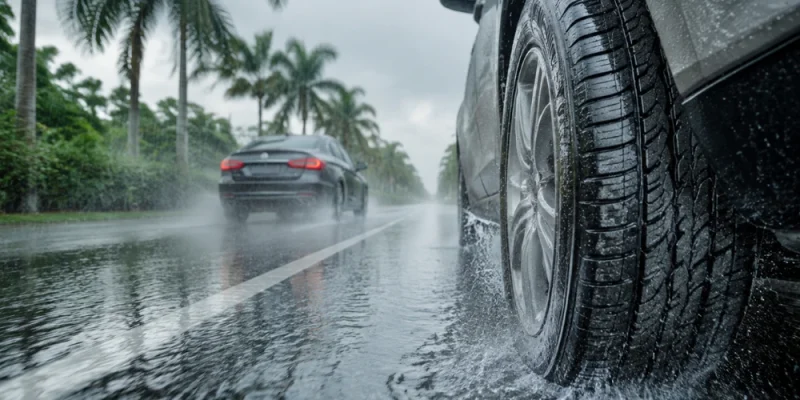
Florida drivers regularly encounter sudden downpours, standing water, and reduced visibility. In these conditions, tire tread plays a critical role in maintaining contact with the road. Tread grooves move water away from beneath the tire so the rubber can continue gripping the pavement.
Although 2/32 of an inch is commonly treated as the minimum usable tread depth, drivers who frequently face heavy rain should not consider that the ideal target. For stronger wet-weather performance, replacing tires as they approach 4/32 of an inch is a more cautious guideline.
Why 2/32 Inch May Not Be Enough for Heavy Rain
Tires contain tread-wear indicator bars that become level with the tread at approximately 2/32 inch. Once the tread reaches these bars, the tire is considered worn and should be replaced. The Florida Department of Highway Safety and Motor Vehicles recommends checking tread depth as part of routine tire safety.
However, a tire can lose significant wet-road performance before reaching the minimum limit. Testing of worn all-season tires has shown that reduced tread depth can increase wet stopping distances and decrease handling ability. The AAA tire study compared new tires with tires worn to 4/32 inch and documented meaningful differences in wet-road performance.
In Florida’s frequent downpours, additional tread depth gives water more space to escape from beneath the tire.
How Tread Depth Affects Hydroplaning
Hydroplaning occurs when a layer of water separates the tires from the road. When this happens, steering and braking response can decrease because the tires are riding on water instead of maintaining full contact with the pavement.
Speed, water depth, tire pressure, tread design, and tread depth all influence hydroplaning risk. A tire with shallow grooves cannot move water as effectively as one with deeper tread.
Even tires with adequate tread can hydroplane if a vehicle travels too quickly through standing water. Good tread depth improves the tire’s ability to manage water, but it does not eliminate the need to reduce speed during heavy rain.
How to Measure Tire Tread Depth
A tread-depth gauge provides the most accurate and convenient measurement. Insert the gauge into several main grooves across each tire, including the inner, center, and outer sections.
Measuring only one location can hide uneven wear. A tire may have acceptable tread in the center but insufficient depth along one shoulder because of alignment, inflation, or suspension problems.
A quarter can provide a quick estimate. Insert it into a tread groove with the top of Washington’s head pointing downward. If the tread reaches the top of his head, approximately 4/32 inch or more remains. This method is only a general screening tool; a gauge provides a clearer measurement.
Inspect More Than Tread Depth
Tread depth is only one part of tire safety. Tires should also be checked for:
- Cracks or cuts in the sidewall
- Bulges or bubbles
- Exposed cords
- Uneven or irregular wear
- Embedded objects
- Frequent pressure loss
- Age-related deterioration
A tire with deep tread may still be unsafe if it has structural damage. Tire age also matters because rubber can deteriorate over time, particularly when exposed to Florida’s heat and sunlight.
Check tire pressure when the tires are cold and follow the pressure listed on the vehicle information label. Do not use the maximum pressure molded into the tire sidewall as the normal inflation target.
Adjust Your Driving During Heavy Rain
Adequate tread cannot overcome unsafe driving conditions. When rain becomes intense, slow down gradually, increase following distance, and avoid sudden steering or braking. Use headlights as required, but do not activate hazard lights while moving unless permitted and appropriate under current Florida law.
Avoid cruise control on water-covered roads, and steer around standing water when it can be done safely. If the vehicle begins to hydroplane, ease off the accelerator and make smooth steering corrections rather than braking or turning abruptly.
For Florida’s heavy rain, 4/32 inch or more is a sensible tread-depth target, while 2/32 inch should be viewed as a replacement limit rather than a wet-weather goal. Regular measurements, correct inflation, and cautious driving work together to improve safety on rain-soaked roads.
This post was written by a professional at Tires2Go Florida. Tires2Go Florida is a trusted automotive service center located in Pinellas Park, Florida, serving drivers across St. Petersburg, Tampa, Clearwater, and Largo. Our certified mechanics handle tire shop Tampa and wheel replacement, brake service, suspension repairs, oil changes, wheel alignments, tire balancing, and road force balancing. We also specialize in ADAS calibration, suspension modifications, lift kits, and lowering kits using quality parts and modern diagnostic equipment. From routine maintenance to advanced automotive services, Tires2Go Florida provides dependable solutions and tires for sale for vehicles throughout the Tampa Bay area.







Comments